
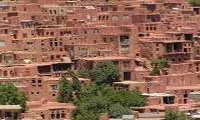
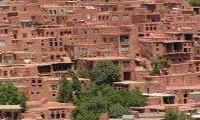
Because of the area being mountainous and away from population centers and communication ways, Abyane people have lived in isolation for centuries and as a result they have preserved many of their ethnic customs and traditions, including their old language and dialect.
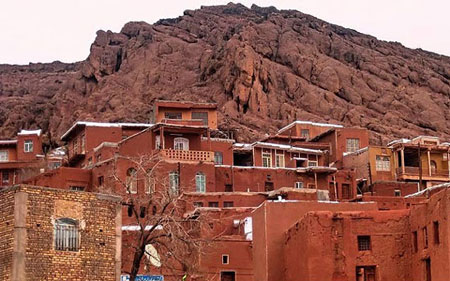
Abyane is a village in the central district of Natanz town, Isfahan province. This village is located in 40 kilometers northwest of Natanz, in the hillside of Karkas Mountain. The village is one of the tallest residential areas in Iran and due to its vernacular architecture and various historic buildings is one of the famous villages of Iran. With its mild climate, Abyane has a favorable natural condition.
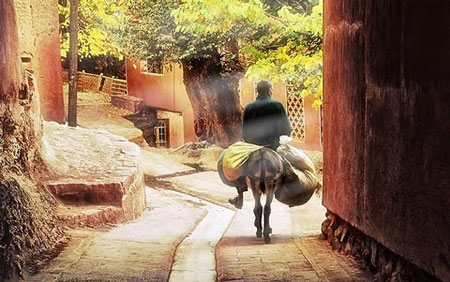
Abyane is called Viuna in local language. Vi means willow and Viuna means land of willow. (Abyane had been full of willows in the past.) Viuna has been changed to Abyane over time.
A document specifying the exact antiquity of Abyane is not available; but 1500 years of history has been estimated for it and it is of the oldest human habitats on the fringes of the desert plain in Iran. Abyane historical monuments are related to the Sassanid period, Seljuk, Safavid and Qajar. These works represent the historic background of the human habitat.
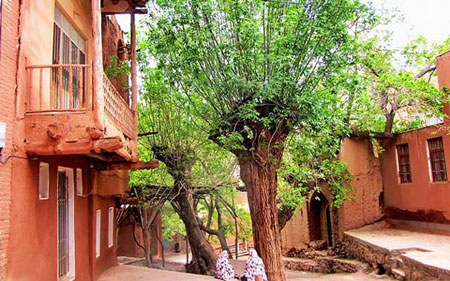
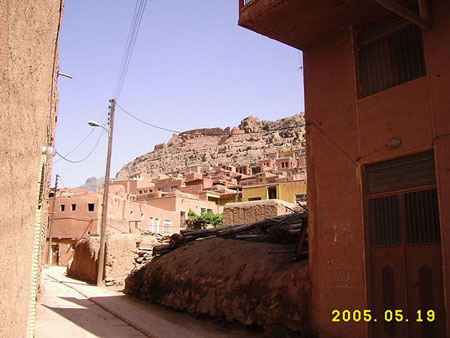
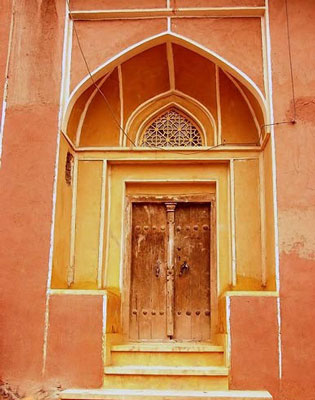
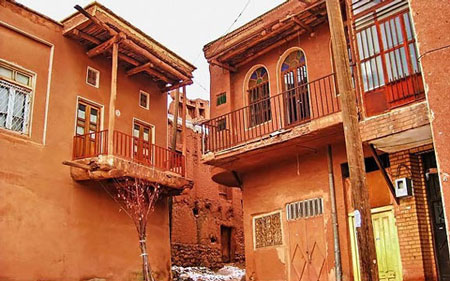
The exterior view of houses has been covered with red soil that is mined in the vicinity of the village. Because of the steep slopes and not existing enough space to build homes, in this village it is a tradition that every family builds a cave like cellar in the hills of one kilometer of the village, along the road and near Abyane. These caves which have been dug in the hills and from the outside just their short doors are visible, are used for keeping animals and winter food and unnecessary objects.
Tourism sites
Fire-temple
Abyane oldest monument is a fire-temple that like other buildings of the village has been located on the slope. Abyane fire-temple is one example of Zoroastrian temples which were built in the mountain communities.Jame Mosque
Another historic monument of the village is Jame Mosque and the oldest historic work of the mosque is its wooden pulpit of fretwork that was built in the year 466 A.H.The mosque is located in the neighborhood of "Miyun Deh" and has two Shabestans, the old one leads to the alley with a short door. Its floor is Wooden. In the southern wall of this Shabestan, there is an old wooden altar which is one of the valuable historic monuments of Abyane and its building dates back to the year of 477 A.H. On this altar flowers are carved and surah "Yasin" is engraved in it by embossed Kofi lines. Some believe it also has writtngs in cuneiform. The mosque has a wooden pulpit which was built on the year of 466 A.H. in Seljuk period. On the pulpit there are floral designs, an eight-petal flower and Kufic inscriptions. The entrance to the mosque is carved with floral designs and embossed ridges. This door once has been robbed. New Shabestan of the mosque is a large hall with a skylight in the center of its ceiling. There are columns with carved tops in the hall. The ceiling of the hall is planked with walnut wood which is framed with regular geometric designs. The ceiling cover is of a vulture (like open wings of a vulture in flight), and on it there are inscriptions from the Quran.
Barzaleh Mosque
Another Abyane old mosque is Barzale. It has an open space and on its eastern door the year of 701 A.H. is written which belongs to the Ilkhani period.Hajatgah Mosque
Another historic mosque of Abyane is Hajatgah mosque. It was built along a rock of a mountain and on the entrance door of its Shabestan the date of 952 A.H. is Observable. Abyane village has two shrines: one is the tomb of Shahzadeh Issa and Shahzade Yahya in southern part of the village that inhabitants believe that they were descendants of Imam Musa Kazim and another shrine of Abyane is called Hinza.Takhte Mahan Castle
Paul Hamoone or Takhte Haman is located in the southwest of Abyane and belongs to Mahalle Bala and Yusmun. The castle was built about 200 years ago and its construction document is also available. In the document share of the people in its construction is specified.These castles were of the rebellion eras, people built them to secure themselves against local rebels kept watch there in turn.
Hinza Shrine
The shrine is located in the southeast of ABYANE in a narrow valley. At the heart of the valley, there is a dent and the shrine was built in front of it, and the dent like a cave has been a part of the building is the shrine. Apparently this shrine is of Bibi Zubaida Khatoon, the daughter of Musa ibn Ja'far. As people say Bibi Zubaida Khatoon was under prosecution and Abyane people helped and hid her in this chamber, then took her to village of Hanjan. In Hanjan a big shrine was also built in her honor. Hinza shrine Zubaida actually was the path of Bibi Khatoon. Some stated that this shrine is of Anahita time. People believe that this place shows miracles and special ceremonies hold there.Shahzade Yahya and Shahzade Issa's Shrine
This shrine which is located in the east of Abyane in Hardeh neighborhood is the tomb of Shahzade Yahya and Shahzade Isa, sons of Imam Musa ibn Ja'far. Unlike other buildings of village, it has a central courtyard and a great water-view in its center that its water comes from the main branch of the village creek. The shrine has an octagonal dome with turquoise tiling. Shrine's porch is designed with inscriptions which recently have been refurbished. Its southern porch overlookes Abyane southern hill. There is no writing in tomb of the shrine, but in the roof of the building there are dates of building repairs and poems and verses. It is said that on the back of the boards behind the ceiling price of grains, such as barley and wheat were written in the past time. An old wooden shrine is also located in the southern porch. The shrine was rebuilt in 1386 by Abyane residents.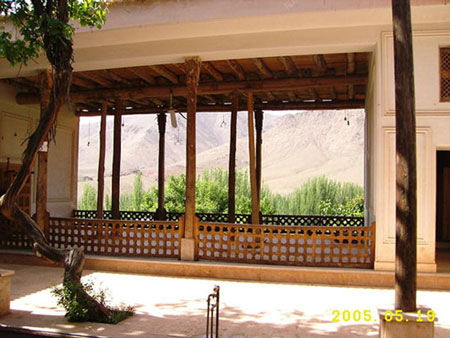
Staying in Abyane
Abyane has a hotel called Abyane hotel. Best seasons to travel to Abyane are spring and summer. Ofcourse fall and winter have its beauty and special viewers and at this time seasonal tours of Abyane hotel can be used. Many visitors come to see the historical village of Abyane on New Year's Holidays, Tasua and Ashura.Features of Abyane Texture
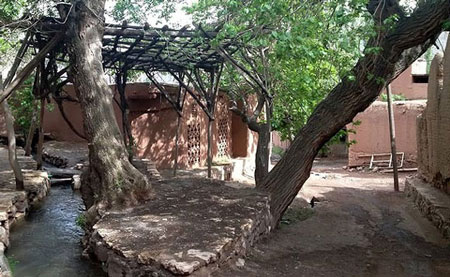
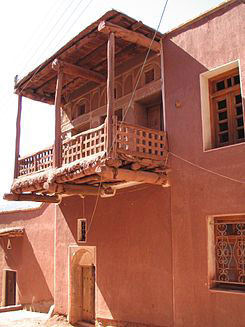
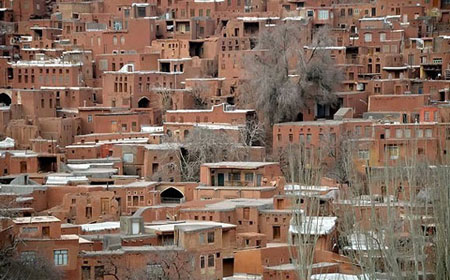
Structural texture of Abyane houses is "spiral-shaped" and it is of Saljughie, Safavid and Qajar periods and there is no dead end alley in the village. Quick and steep mountains connect home and garden from north to south and vice versa. In narrow and crooked lanes which were built to break wind, smell of soil creates a sense of lethargy in us in a way we are going to think for hours. Abyane has three neighborhoods: Pol (which means above), Yasmun, and Hardeh (which means the lower part of village). Old buildings of the village with a cover of "red soil" in the uniform slope of the gray mountain are like dancing flames of fire on the ash. This red soil has a kind of property in a way that the more rain pours on it, the firmer the soil will be, Just like people of Abyane that stand against accidents and natural disasters such as earthquakes and floods as patient as a mountain and as resistant as a cliff and with the love toward the tradition and architecture of their ancestral land and to all the memorials of their ancestors, and in any repair they have kept the building style.One of the features of Abyane historical village is the red color of its soil that has given a certain effect to the facades of its buildings and has introduced Abyane as the red ruby of desert.
/J
.jpg "Beautiful Nature")
.jpg "Beautiful Nature")
.jpg "Beautiful Nature")
.jpg "Beautiful Nature")
.jpg "Beautiful Nature")
.jpg "Beautiful Nature")
.jpg "Beautiful Nature")
.jpg "Beautiful Nature")
.jpg "Beautiful Nature")
.jpg "Beautiful Nature")
.jpg "Beautiful Nature")
.jpg "Beautiful Nature")
.jpg "Beautiful Nature")
.jpg "Beautiful Nature")
.jpg "Beautiful Nature")