
Translator: Fatemeh Rezapoor
Source: rasekhoon.net
Source: rasekhoon.net
There are many celebrations in Iranian culture which are the relics of the ancient and pre-Islam era. This celebration which are rooted in ancient beliefs and ancient religion not only are not destroyed due to devastating attacks of various ethnic groups in Iran but also they are still popular among the general public and executed. The present study investigates Sadeh celebration and holding it in the contemporary era and it has evaluated the acceptance and belief of people to this faith by evaluating the Iranian literature and poetry.
Abstract
There are many celebrations in Iranian culture which are the relics of the ancient and pre-Islam era. This celebration which are rooted in the ancient beliefs and ancient religion not only are not destroyed due to devastating attacks of various ethnic groups in Iran, but also they are still popular among the general public and executed. The present study investigates Sadeh celebration and holding it in the contemporary era and it has evaluated the acceptance and belief of people to this faith by evaluating the Iranian literature and poetry.
Keywords: Sadeh, celebration, religion, national
Introduction
There have been many rituals in Zoroastrianism religion and the culture of ancient Iranian people that Arab considered many of these religions abomination due to dominance of Islamic culture and they expressed that performing them according to Islam religion is heterogeneous. It seems that this is why that many of the customs and culture of the Aryan people which were done before Islam are combined with Islamic culture and its only reason can be the efforts to survive these national religions and insist on doing it. Despite Arab invasion, the destruction of many books related to before Islam seems to be strange at the first glance that still, many of these religions are implemented and even, they have national and patriotic aspects. At a time when the Zoroastrian were called Gabr and even decorating markets and celebrating these festivals was considered abominable; these celebrations not only were not forgotten but also, they are implemented according to the old traditions despite repeated barbarian attacks such as Arabs, Mongols and the loss of cultural heritage.
There are numerous and various national festivals in the ancient Iranian culture such as Mehregan, Yalda night, Sadeh celebration, Chaharshanbe Souri, Norouz, and etc. that their main characteristic is making fire as an element which gives birth. According to the calendar of ancient Iran, the year has been divided into two parts. 7 months summer and 5 months winter. The summer began from April to October and the winter began from October to March, respectively. Iranians were held Sadeh celebration hundred days after the beginning of winter. This celebration not only is held by Zoroastrians in Iran but also, it is held in other parts of Iran including Kerman in public by people.
The author has tried to evaluate the reason for establishing this celebration, its holding and also performing it after Islam by various literary books and numerous articles.
Sadeh word
It consists of two components. Sad (century) and eh which is the proportion extension. Sad in Avesta and Sanskrit is Saδa which is derived from Sand word and it means to achieve. Eh in ancient Persian is aka which exists in words such as bandaka (servant) and kanaka (Kama) (Pourdavoud, 1324: 3, 4).
The term sada (female name) which means the establishment and appearing and it was sadak in ancient Iran and it was sadag in Middle Persian. Lexical meaning of Sadeh is attributed to Sad star which is applied to deliver. Also, it is meant as high flame fire (Rouh Al-Amini, 1374: 303).
Appellation
1. One day Houshang went to the mountains with his friends and a great snake came to him and his friends. He threw a stone into a snake. The stone went on a stone and the fire was appeared from the collision of the two stones and the snake was burned. Of course, the word 100 was not mentioned.
2. GONABADI in describing 20 cases about it written that since, Kiomars had 100 children and when they were fully grown; they held Celebration and named it Sadeh (Pourdavoud, 1324: 5).
3. Gardizi, the author of Zynalakhbar has said that the children of some people reached 100; they celebrated this event and named it Sadeh (Ibid, 5).
4. Ermaeil, the minister of Zahak, everyday survived one of the two persons which must be killed. When Fereydoun won Zahak, the number of those released was raised to hundred people. Ermaeil informed Fereydoun, but Fereydoun did not believe and sent some people to seek the truth. Those 100 people kindleth a fire on the roof of homes. Inspectors saw and reported to Fereydoun. The released people celebrated this success and named it Sadeh celebration with the validity of being a hundred people. This point is come in the book of Al-Tafhin by Abu Rayhan Biruni in the late 4 century, but, Ferdowsi also referred to this in his book, but, he said nothing about the fire (Birouni, 1367: 258 and 257).
5. Because with the passage of one hundred days of the winter, the cold reaches its climax and then, it becomes weak; people celebrated the happiness this weakness and deterioration (According to ancient Iranian calendar which was divided into two parts, 7 months summer and 5 months winter; the spring, summer, and the first month of the autumn was the summer and from October to the end of the 5 months was the winter). Therefore, Sadeh Celebration was exactly 100 days after the start of this 5 months winter and it was named Sadeh due to the 100 passed days from the beginning of the winter. This Appellation apparently was until Sassanid era, because over time, the distance of November to January was not 100 days but also, it was 105 days and Sadeh Celebration reached January 25 that they did not consider these five days (Pour Davoud, 1324: 13).
6. There are fifty days and fifty nights from Sadeh Celebration to Norouz which are totally one hundred days and nights. For this reason, Sadeh Celebration was held fifty days before the New Year (Al-Tafhim, 1367: 257).
7. There are one hundred days from this day to the day of gathering grain in the south of Iran and for this reason, this celebration was named Sadeh (Bahar, 1374: 630).
The reason for lighting fire in the Night
Master Mehrdad Bahar in the book of searching in ancient Iranian culture considered lighting fire as the belief and idea of the people at that time to the sun and he said that Sadeh Celebration is not a quite Zoroastrian celebration and there is no word in Pahlavi contexts. Sadeh Celebration, in fact, is the forties celebration of the sun. This means that forty days after Yalda night is the birthday of the sun that they made fire and this was considered as the magic of warming the world (Bahar, 1374: 233).
In ancient times, people believed that they could change the world by bringing the magic of the forces. One of the most common of these magic was the wind and rain. Also, one of the strengthening and accelerating magic was the magic of strengthening the sun and accelerating the heating. This action is usually coupled with lighting fire and it is based on thinking that creating fire like the fire of the sun on the earth makes the sun warmer and stronger. According to this, we are faced with a ritual in the ancient Iran in which, fires were kindles on the ground, cities were decorated and birds and fire beams were sent into space unless the childhood period of the sun be ended and its heat be emerged and the fertility of the land be re-started. Lighting fire at nights means that killing darkness was common in the winter festivals, but apart from lighting fire, performing this ceremony at night is important. Nights represents darkness and this darkness represents the primitive confusion which was prevailed on the world in the primitive human thought. Lighting fire at night means a kind of returning to the beginning and a kind of re-creation of the world. (Bahar, article 635).
The tradition of this celebration
This celebration is held in the evening of January 30 (10 Bahman). Everyone went to the desert and provided mountains by plants and kindled them and enjoyed and they believed that this fire destroys the remnant of the cold. Gathering these plants was considered as a common ordinance and they hired great men and women to gather plant instead of themselves.
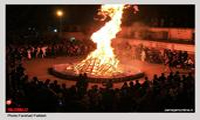
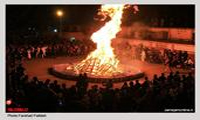
Since, today, this ceremony and ritual is held publicly in Kerman thus, it is considered as the ancient traditions of this region. Preparing celebration is done from a few days ago and in the years that traditional agriculture was still current. From January, farmers and owners of agricultural lands which were mostly Zoroastrian collected firewood gradually and to the extent of their effort and wealth and they brought them to the place until January 29 (9 Bahman). Sadeh which is a big harvest of firewood with the diameter of 12 to 14 and with the height of 5 to 6 meters is prepared in the shape of cone previous. Near sunset 2 priests while whispering get close to Sadeh with tulip in their hand and white cloths (which is the official garments of the priests in performing religious rituals). They walk around the Sadeh three times from the right side. Then, they light this harvest firewood with the flame of tulips that their lightness if from the fire that is come from the fire temple at morning and they fire the Sadeh from four sides. Some farmers try to take some ash and bring heat to their farms to a sign of the end of the winter. At this night, heat star comes on the Earth (Rouh Al-Amini, 1374: 312).
Farmers believe that when the fire particles of Sadeh drop on the ground, the earth breathes and gets ready to growth plants. For this reason, they consider its ash sacred and pour it small bags and put it on the flour or leave it at the place and pray for rain to have a good year (Shariatzadeh, 1371: p418 citing an overview of Sadeh celebration.)
Reflection of Sadeh celebration after Islam in literary texts
Sadeh celebration was held after Islam and the documents that proves the claim, are literary works and books. Previously, Beihaghi in his famous work of Beihaghi history described this celebration which was held by Sultan Masoud Ghaznavi.
Conclusion
Sadeh celebration is one of the ancient and national celebrations of Iran which was not gone away and forgotten. Evaluating the aspects of this celebration and its emergence show that growth and birth are very important for Arians so that they sent force toward the sun by lighting fire 100 days after the beginning of the winter for re-grow which was re-warming and coming summer. Here, the importance of fire rises as a symbol for birth. By evaluating its reason, one of the causes of the honor of Zoroastrians to the fire is cleared. The most important point which is found in this investigation was the importance of this celebration as a national and patriotic celebration that is not destroyed over the centuries. Perhaps this should be considered due to the Zoroastrian and Clergymen priests who remained the treasures of the ancient Iranian traditions and maintained traditions and culture of the Iranian and Aryan in the pre-Islam by living in the mountains and rugged places and protect these celebrations after Islam against any non-Iranian. Sadeh celebration not only was an obvious sign of Iranian culture in pre-Islam but also, it showed the resistance of Iranian as the guardian of the indigenous culture of Iran against attacks and impacts of foreign cultures and this protection not only was done by the Zoroastrians, but also, all the people of this land including the Zoroastrians and non-Zoroastrians care about this celebration as an Iranian person and they attempted to hold it that its obvious sign is holding this celebration publicly every year in Kerman.
/J
.jpg "Beautiful Nature")
.jpg "Beautiful Nature")
.jpg "Beautiful Nature")
.jpg "Beautiful Nature")
.jpg "Beautiful Nature")
.jpg "Beautiful Nature")
.jpg "Beautiful Nature")
.jpg "Beautiful Nature")
.jpg "Beautiful Nature")
.jpg "Beautiful Nature")
.jpg "Beautiful Nature")
.jpg "Beautiful Nature")
.jpg "Beautiful Nature")
.jpg "Beautiful Nature")
.jpg "Beautiful Nature")