
Source: www.rasekhoon.net
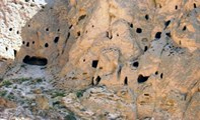
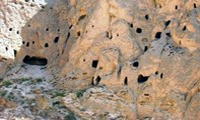
In the region of KAFARKALI, along the HARAZ valley, from ESK village upto village of PANJAB, with the length of 250 kilometers in the mountains, overlooking to valley and in the side valley, there are nearly 250 rooms are located in the rock. This series in its kind in the case of concentration in a region, is unique in Iran.
After verification, we came to know that, in axis of HARAZ, in 13 points, we are facing variable number of caves in heart of mountains:
1-DASTKAND caves of ABESK village.
2- DASTKAND caves of NIYAK village.
3- DASTKAND caves of AYENE MAMNUN valley, in front of NIYAK village in right side of HARAZ road.
4- DASTKAND caves of TAKHTE POL (wooden bridge), between villages of NIYAK and PELMON.
5- DASTKAND caves of DARSUN, 3 kilometers away from the REINEH city.
6- DASTKAND caves of GILAS (cherry) village.
7-cave series of DASTKAND, PELMON village.
8- DASTKAND caves of KENARANJAM village.
9- DASTKAND caves of ABGARM village.
10- DASTKAND caves of GAZANE and MALAR villages.
11- DASTKAND caves of BAIJAN village.
12- DASTKAND caves of KAHRUD and KIYAN villages.
13-cave series of DASTKAND, PANJAB village.
Internal structure of these caves have no particular order. Some of them have single input entrance, and some of them have corridors for the connection and some other have been made by a hole of approximately one square meter in the roof to access the second and third floors. Most of DASTKAND colonies have many rooms along with skylights and scout locations, bathrooms, toilets on the upper floors (crags were used as wastewater well) and the kitchen.
DASTKAND cave (KAFARKALI) in PELMON village:
85 kilometers away from AMOL city and with a distance of 700 meters from north way and HARAZ river and also in east of PELMON village, there is a road toward the city of REINEH and village of ABGARM, in the escarpment of mighty mountain, there are 35 catacombs, up to 100 meters inside the mountain. These catacombs are just like shelters and strong castles, entering to some parts are impossible and the only way to access them is rock climbing. These stony catacombs are the most prominent samples in HARAZ area and even Iran. All the floors are in connected to each other. Some of door walls were decorated, from the floor to a height of 60 cm with thatch and ocher (in stony catacombs of AB ESK, same case is there). Creating a defensive wall with stone and mortar as well as general elements which were mentioned above are just some specific characteristics of KAFARKALI in PELMON village, which was mentioned earlier.Inside the rooms, there are some small and big shelves, to hold and put instruments and life tools and or war weapons. in one of the rooms (first floor), stone columns, sticking to the floor and wall of the cave, at a height of 50 cm and a diameter of 20 cm, has been created in the form of hole and clamp, and that is likely were used to close the animals. Same sample can be seen in MEIMAND of KERMAN. And they are using it for the same work.
DASTKAND caves (KAFARKALI) of AB ESK village:
These catacombs were dugout in north of HARAZ road and by the side of HARAZ river and in east of AB ESK village, by the distance of 90 kilometer from AMOL city, inside a long mountain. HARAZ River is at the foot of the mountain. Stony catacombs were dugout by the distance of few meters in foot of the mountain, in some parts, their distance from the crag is only, half a meter. DASTKAND caves (KAFARKALI) of AB ESK, on the concept of numbers are less than DASTKAND caves of PELMON. And only one of these is multi-floor, and entrance way is from the east wall of the first floor with digging some foot step. And the entrance way to the upper floors in other catacombs of HARAZ way is mostly through a hole in the roof of the path. Some of them have platforms with the height of 60 cm with different lengths. Entrances are in the forms of arch and vault, and some of them have skylights, and we can assume, KAFARKALIS of ESK are older than KAFARKALIS of PELMON. Because these catacombs,are very simple, and structure of PELMON catacombs are seen very less in them.
By verifying the DASTKAND cave of AB ESK, only one cave with very beautiful double floor has been constructed, which includes an open room with a shelf in east direction. second floor with a platform, arched entrance, a room with dimension of one into two meters, in the east of this room, there is a hall with height of one meter, and a person in a bend shape, can enter a space which contains a toilet along with a bathroom (probably) with a platform with height of half a meter and length of one and half a meter was created.
it is necessary to say, at present, some parts of DASTKAND caves of AB ESK village by local villagers became livestock feeder and feed storage, or maybe these catacombs were created for this purpose from the beginning. We have to add that, only in the catacombs of above mentioned villages, we can see the multiple application of such things in a vast case.
In research and survey from DASTKAND caves of DARSUN, in a distance of 3 kilometers away from the city of REINEH and stony catacombs of PANJAB village, nearly similar structure and elements are there in catacombs of PELMON and the village of AB ESK. in this regard, catacomb of AYENEH MANUN valley, in the path of HARAZ road and in front of NIYAK village, is in double floor and it is unique in own kind. And a research was conducted about it. The only stony catacomb of wooden bridge is between catacomb of PELMON and valley of AYENE MAMNUN, with linear and horizontal structure (floors are not on each other), because of ruggedness, no body performed a research about it. And there is no written resource about presence of anyone, and no scientific research, has been registered about it.
The reason to reference the DASTKAND caves to historical era of Medes rule, is because of presence of many tomb catacombs of Medes period in this area. So many minds were attracted to this point.
but announcing the catacombs of HARAZ area to Medes period with differences in type of architecture of catacombs with catacombs of Medes period (such as lack of presence of specific figure, architectural elements like plinth, columns, barnyard and similar architectural constructs, which has been found in Medes catacombs), is not acceptable. Catacombs of HARAZ area are free from decorations and inscriptions and also catacombs of HARAZ area were having residential, fort and scout applications. But tomb catacombs of Medes people were used for burial purposes, and probably, they were using them in special circumstances.
Existence of this architecture, no doubt, was created for the sake of defend against the attackers.
As we know, in early Islamic centuries, MAZANDARAN province, was not accepting the new religion for one or two centuries. And were fighting against the new comers. And these resistances in this part of TABARESTAN, could not be far-fetched.
Weather these catacombs were the places to struggle against Arabs?
In term of use, the caves of DASTKAND can be divided in to four categories:
A-temporary living and defense.
B-permanent living.
C-rituals and burials.
D-Mine.
The mountain, where the catacomb was created (because of stone type), is not so rigid and hard and easily can be dugout by pick and crowbar.
Address: AMOL, AB ESK till PANJAB.
/J
.jpg "Beautiful Nature")
.jpg "Beautiful Nature")
.jpg "Beautiful Nature")
.jpg "Beautiful Nature")
.jpg "Beautiful Nature")
.jpg "Beautiful Nature")
.jpg "Beautiful Nature")
.jpg "Beautiful Nature")
.jpg "Beautiful Nature")
.jpg "Beautiful Nature")
.jpg "Beautiful Nature")
.jpg "Beautiful Nature")
.jpg "Beautiful Nature")
.jpg "Beautiful Nature")
.jpg "Beautiful Nature")