
Translated by: Mahvash Kavian
Author: Homayun Elahi
Source: WWW.rasekhoon.net
Author: Homayun Elahi
Source: WWW.rasekhoon.net
Source: Book, The strategic importance of Iran in World War II
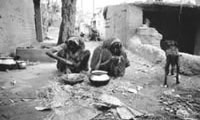
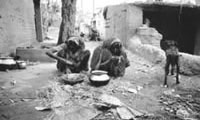
Soon after the military invasion of Iran via allied, the shortage of food products for the people was more perceptible day by day. According to the Article Seven of the Imposed Pact popularly known as the ``Three-Way Pact’’ , dated 29th July 1942, the occupant states had imposed to provide the dietary consumption of its divisions via the imports and in this manner led to the shortage of food products and famine in Iran. But very soon it became clear that the provision of the needed food products of an invaded army comprising of one hundred thousand individuals and even a group of one hundred thousand individuals of Poland Military Avargan that released from the jails of Russia and expedited to Iran, is impossible via the imports of food products. Because apart from the transport issues and lack of a sufficient number of freighters for the transport of required provisions from remote points of the world to the territory of Iran was a basic issue similar to lack of access of allied to the sufficient food products for the supply to Iran. For the same reason, the occupation authorities of the transgressor armies possessed the entire accessible provisions with the force of the spearhead and or with the payments of at least the possible price.
The invaded section of the Soviet Russia, which is one of the main centers for the production of wheat and rice and etc., via that government got completely separated from the other sections and was placed behind the ``Iron Curtain’’. And as a result the production of this section was confined to the control of the Russian Soviet authorities that, of course a part of it was allocated to the internal section of invasion ``And from this viewpoint the people of this order in comparison to the other points of the country had a more suitable condition’’ and the remaining was exported to the Soviet Russia. But England in these terms followed a method that was crippling of his colonialism politics in Iran. The English authorities via an English company known as the United Kingdom Corporation Company could purchase the accessible provisions up to the possible extent, almost free of cost and stored in the ``Power Center of England’ in Ahwaz.
The shortage of food products along with the inflation of approximately 1000 percent, was created due to the adoption effect on the financial politics of the occupying power, which in turn intensely reduced the purchasing power of the masses and as a result several thousand people around the country suffered from hunger. The situation till the end of 1942 became much more severe to an extent that in the December of 1942 eventually the people in Tehran formed a protest campaign against the shortage of the provisions. The building of the assembly was occupied by the protestors. This action in reality was the expression of the lack of willingness and their opposition with the betrayal of the regime that had exclusively surrendered the Iranian territory in the hands of aliens. A few days after this occurrence, when the English soldiers for magnification of their power and terrorization of people entered Tehran, people expressed their hatred and disgust by attacking them. This incident, that turned into a street war between the army till it turned into the armed tooth of England and unarmed people of Tehran, and left hundreds wounded and killed, that indeed during this period the devoted regime had allotted time for these covered incidences and supported the allied nation in the transgression and plunderage of this motherland.
The actions of the English authorities in Iran was so much non-human and unreasonable that even the ambassador of the United States of America in Tehran expressed that:
``…….It is felt that the government of England deliberately does not want that a preventive measure is taken against the hunger and famine’’.
This doubt and assumption of the ambassador of the United States of America could be justified as follows:
The United Kingdom who had taken the responsibility of provisions to satisfy the English, American and Polish forces did not fulfill the commitments that it had undertaken according to the aforementioned Three-Way Pact. In addition, the English authorities with enthusiasm were preventing the improvement of the provisions market condition in Iran. For an example, after that the famine had ruled a much irregular state in the country, under the pressure of the United States of America government, England in November, 1942 became a guarantor to send 3500 tonnes of wheat from its storages in Iraq to Tehran, in order to temporarily recompense a bit of the shortage of bread in the capital. But in action the United Kingdom with different excuses and besides with the excuse of unavailability of the medium to transport wheat from Iraq to Iran, prohibited the delivery of this amount of wheat. It is quite interesting if it is mentioned that a little after that, the spy organization of America discovered that the English authorities in action had in reality transported the considered wheat from Iraq to Ahwaz, but had prohibited its delivery to the Iranian authorities and in this manner the excuse for the shortage of transport medium was nothing more than a lie. The ambassador of the United Kingdom in Tehran in a meeting with the prime minister of Iran justifies the reason of this hostile method of the United Kingdom in relation to the nation of Iran: `` The United Kingdom does not see any reason to assist the people of Iran, they in any state are against the United Kingdom.’’
The below example is another prominent sample that shows how the United Kingdom was neutralizing any kind of efforts in the route to the improvement of the conditions of the provisions and elimination of the famine:
The authorities of the Soviet Russia in the invasion section of northern Iran declared that they are ready to accredit to the government around 35000 tonnes of their grain products of their invaded section in order to get transported to other points of Iran. But the transport of this amount of wheat was not possible for the government, because the entire utilizable transportation means in Iran were occupied by the allied except a few numbers of trucks that also due to weariness were not utilizable. Probably the occupation authorities of the Soviet Russia also with knowledge of lack of Iran’s ability to deliver and transport these wheats and merely for the use of propaganda, had presented such a proposal. But the Iranian authorities in order to resolve the famine should in any possible way repair the corroded and outdated trucks and again make them reusable. But these commodities when reached the ports of Iran were occupied by the English occupier authorities and its delivery to Iran was prohibited.
When we position this method of the United Kingdom opposite Iran and analyze it, with attention to the irregular situation of the allied in the war fronts, in winter of 1942, these actions of English authorities even was against the interests of allied. Although the politics of the United Kingdom was settled on this principle that with the instablility of the country administration system via dissemination of the famine, hunger and poverty destroys the ultimate resistance of remainders in the nation of Iran so that in that medium from one hand achieves its short-term targets, i.e. the complete control of Iran government and conquest of Tehran and from the other hand, in the long-term confirms its position opposite the ever-increasing influence of the United States of America and the Soviet Russia.
The United Kingdom with adoption of this method gained its short-term targets and could during the years of war access its considered political and economic resources. But to a large extent was unable to attain its long-term targets. Conversely the unfriendly method of the United Kingdom against the people of Iran made the route smoother for the increase of the influence of Americans in this country. From this aspect after the war the United Kingdom could never succeed to gain its past influence in Iran.
The Americans in the beginning of 1941, entered Iran as a section of the English forces, and soon could attain a total control on the political and economical life of Iran. The consultants in the United States of America, even in 1943, possessed the key posts such as chief of police headquarters, the Ministry of Economics, etc. and in short they became the heir of the United Kingdom in Iran and in this manner the inflection point in the history of Iran was created.
The military confluence of allied in 25th August 1941, was indicative of the perpetual imperialist politics of superpowers against Iran. The politics that from the beginning of 19th century A.D. had radiated the political life of this country.
Although the aforementioned military attack was not the highest point of the imperialist politics, but it caused that the effects of the inflection point remain effective till date in Iran and these effects can be divided as follows:
A - In the outcome of the Iranian military invasion via allied, the groups that internally for the warfare with the United Kingdom imperialism had hopes on the support of the government of the Soviet Russia, for the second time became much disappointed because the governments of the Union of Soviet Republics and the United Kingdom with total cooperation and harmony transgressed the territory of Iran and divided this country among themselves. Likewise, that group of Iranian freedom fighters that as a refugee stood against the influence of the Soviet Russia and the United Kingdom soon realized that this country also like other powers were only thinking about their interests and as an when required made Iran interests victim of access to their targets. However, in 1940, Hitler for the attraction of the support of Soviet Russia formalized the territory of Iran as the influence module of this country.
The despair of the Iranian military forces from the Soviet Russia and Germany’s Hitler and as well the weakness of the United Kingdom created a vacuum of existence in Iran that due to its effect the government of the United States of America as a patron of the international world, could increase its influence. Following it, in the second half of 1942, the American consultants conquered the key posts in Iran such as economic, army and the chief of police headquarters.
B - Presence of United States of America in Iran, that initially was accepted as a martial necessity, soon ignited the doubt and cynical of the governments of the United Kingdom and the Soviet Russia. This lack of confidence and cynical instantly turned into the ``Power War’’, the power war that got crystallized in the form of strive of these governments to access the oil privilege in Iran.
Following the appearance of the absolute defeat of Hitler’s Germany in the war front of the Soviet Russia in the summer of 1943, the all sided efforts in the acquisition of the oil privilege in the territories outside of the oil territory of Iran company and the United Kingdom initiated. In the autumn of 1943, the English company Shell sent a representative to Iran in order to discuss the oil privilege of the Sistan and Baluchistan province with the government. The American Standard Vacuum Oil Company and Sinclair Oil Company demanded the oil privilege of the northern Iran.
Even the Soviet Russia in order to avoid lacking behind the caravan dispatched its representatives to Tehran for the coalescence of an oil deed pertained to the northern sections of Iran.
The two essential points are visible in these efforts. Primarily the concurrent of Soviet Russia and England and the continuation of the imperialist cooperation of the two aforesaid powers, via respect to the agreement series 1907 that was concluded between the empires of England and Tsardom of Russia and distinguished the influential modules of the aforesaid governments in Iran. Although the leaders of October Revolution apparently declared this agreement annulled, but virtually was considering it honorable. Though it was able to fulfill the aforementioned oil privilege demand, the government of England had demanded the oil privilege of Baluchistan and Soviet Russia and oil privilege in the northern parts and these two parts of Iran territory according to the agreement series 1907 was formed by influential modules of England and Russia respectively.
Secondly, considering the above matter, it seems that the main purpose and aim of England and Soviet Russia governments via the insistence in purchase of oil privilege for the said parts, was more to deprive the government of America to access the oil privilege in these territories and as a result prevention to the influential advancement of the last mentioned governments in these modules.
Since the pressure and terrorization of the allied increased due to the signing of the oil agreement with Iran, the militant forces in the National Consultative Assembly in 1944, passed a law from the assembly that according to which the Iranian government was prevented from any kind of negotiations and agreement contract in case of oil with foreign governments. It was only under this condition that the Iran government could refuse the entire demands of triathlon government for acquisition of oil privilege. Indeed, this method of Iran government instigated the unfriendly reflux of the Soviet Union. The Moscow regime believed that this action of Iran was to stimulate as well as was plan of western governments and following such a reaction the allied governments initiated a propaganda war against one another. The government of Soviet Russia accused America of following the imperialistic targets in Iran and the American government also in its own turn believed that the Soviet Russia was striving to expand its influence till the Persian Gulf. The initiation of ``the Cold War’’ that casts its shadow for prolonged years after the World War II on the terms of superpowers, in reality was resourced from the Iran events.
C) With proximity to the end of war, the conflicts between the allied governments in Iran became intense up to an extent that the regimes of Soviet Russia and England had organized numerous insurgencies in different provinces of Iran and this operation continued till the mid of 1946.
Considering the intensification of the political crisis of the world, in the years after the Second World War and soaring of the cold war between the capitalist governments on one hand and communist countries on the other hand, the Iran assembly found the period suitable to enforce in order to release Iran from the yoke of super powers. From the viewpoint that the best route to gain the freedom and independence was via the advancement of economics and self-sufficiency of the country was possible, the Iran assembly presented a seven year economic expansion program. For the provision of the financial costs of this seven year program the assembly demanded a higher share of the oil income from the oil company of Iran and England.
England who had foraged Iran oil for prolonged years and had authorized it in an unlimited manner, it is obvious that it was not ready to even negotiate in this affair, wherefore it will give a share of the enormous income of Iran oil to Iranians. The aforesaid government for magnification not only did not sign the demand of Iran’s increased income from oil, but also in contrast with the new decisions and arrangements that it adopted even practically reduced the flowing income of Iran from the oil. Following this action, it was the government of England that caused a crisis in the terms of the two countries viz. Iran and England that continued for two years and in this strive America for settlement of the existing differences, that knew its continuation for the benefit of the influential advancement of Soviet Russia in Iran, did not achieve any result and finally the two-sided, two years negotiations between Iran and England reached a dead end and led to the cancellation of diplomatic terms between these two countries. Following this crisis, Dr. Mohammad Mosaddegh, the Prime Minister of Iran in 20th March 1951 nationalized the oil industry in Iran. This impetuous action that itself was the origination of many transitions in world in reality shook the hundred and fifty years old power foundations of England imperialism in the Middle East. The exploration of the history after it shows that the English colonialists not only could not save their lives from this blow, but also the nationalization of the oil industries chimed the death of an emperor.
Footnotes:
1- United Kingdom Corporation Company2- The imperialist politics of the super powers in Iran are encountered with special characteristics. This means that the superpowers ``and during the period of discussion, especially England and Soviet Russia’’ from one side were striving so that with concurrent of one another achieve the highest possible economic and political privileges and on the other side block any kind of opposite power influential advancement, for what they had accepted in an incidental or according to the confidential letters of agreement.
3- Standard Vacuum Oil Company
4- Sinclair Oil Company
.jpg "Beautiful Nature")
.jpg "Beautiful Nature")
.jpg "Beautiful Nature")
.jpg "Beautiful Nature")
.jpg "Beautiful Nature")
.jpg "Beautiful Nature")
.jpg "Beautiful Nature")
.jpg "Beautiful Nature")
.jpg "Beautiful Nature")
.jpg "Beautiful Nature")
.jpg "Beautiful Nature")
.jpg "Beautiful Nature")
.jpg "Beautiful Nature")
.jpg "Beautiful Nature")
.jpg "Beautiful Nature")