
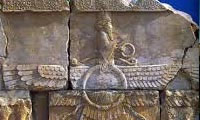
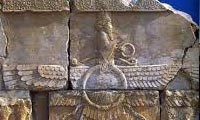
Generally, Iranian art position in the world has a fundamental difference with the position of Western art. When this art schematically was displayed with dramatic and allegorical character, it abandon whatever specifying the time and place: “The king getting the lion that is engraved on the gold plates in Gang e zivieh Kurdistan, and winged cows that are engraved on the edge of golden tub related to the northwest of Iran do not show a personal accident. Movements have a special style and reliefs do not have shade. Any real tree is not seen. There is no visual design [realist landscape] that refers to the world we live in. Two centuries after that, these characteristics appeared in Persepolis artworks.”
There are same face reliefs on the stone walls of Persepolis. There are carved trees among them that have been created in a particular style. They are also located at certain intervals like the people. These designs also do not indicate a landscape, but they have been created to give coordination to this combination and visualize the trees in an abstract concept.
"The ancient sculptor created pleat on the body of a sculpture; because he wanted to create impeccable curves like calligraphers. Designs of a smile are engraved with a perfect skill which did not show any weakness in the artist's work. Parades of guards and organizers do not want to describe what is in reality, but also it represents the image out of place and time and it is abstracted from side factors.
This vision or concept that came from the ancient East and Greek art was shared in it until it remained Asian absolutely in contrast with Western Art, as the traces of Greek was created since Pericles time and passionately worked on realistic and ideal visualization of human.
At that time, East face was a desired the ultimate pattern and West face was an image. The study of human physical characteristics, search in psychology differences and his thought constantly occupied Greek artist to itself. Over the centuries, this artist has amplified the details that considered them as the original and new details. Achieving perfection in observation of the human body and elements of nature, skill for imagination the depth of space, following perspective rules and the way that today's art critics in Europe (with admiration) say, skills in impart spirit and life were considered as the final criteria and Iranian Achaemenid art avoided all this cases and even seems to be abhorred.
Establishment of a series of Greek (Seleucid) after Alexander's attack to Iran and entering many Western could bring out Iran of its recess and drive its direction of art to the naturalistic description that was intended in Europe and still is. But it did not happen; Greek art in Iran that had random aspects in the early Part period (Parthian) remained in retardation and even complete nudity.
Acceptance of the West (Greek) art in Iran failed that could be considered voluntary. As if it had a completely alien position to the way of understanding the world in the oriental style. It could be just a bad patch and when the Sasanian period began in 224 AD, Iranian art got back again to Eastern origins and its national creativity.
Dexterity riders who are seen on the side of Fars rocky mountain wall’s reliefs, well as Behistun and Tagh e Bostan or in the middle of the silver cup leap in space that does not belong to our world.
When the ancient goldsmith wants to image a landscape; he shows it with the help of a mountain with three small peaks and imagines the thought in the sense of the Platonic world means in an ideal and an abstract method.
During the different styles which were come into existence by time and place, Iran has never distracted from its basic position throughout its history of art.
As a result, Iranian art unlike the western art attempted to remove secondary or ancillary factors from all scenes and remove the ornaments from personal characteristics or individual faces and in general, appearances of the world throughout its history and could create a utopian scheme from human, life and nature that became example or index of art based on codes and symbols - an idealistic and romantic style (stylized) art both in content and form which is a general feature of ancient Eastern art, like the creative approach that Iranian calligraphy art has done to make itself unique in two dimensions with real three-dimensional space.
We can stay hesitated in the interpretation of these patterns’ originality for aesthetics of visual arts when literature aesthetics and decorative arts of Iran allow us to recognize the truth that those two indicates a way of understanding the world: The understanding that was opened to the world with the advent of Islam in the fourth century by Iranian poets in their poems and stories and since the fifth century by the skillful miniaturists and illuminators of this land.
/J
.jpg "Beautiful Nature")
.jpg "Beautiful Nature")
.jpg "Beautiful Nature")
.jpg "Beautiful Nature")
.jpg "Beautiful Nature")
.jpg "Beautiful Nature")
.jpg "Beautiful Nature")
.jpg "Beautiful Nature")
.jpg "Beautiful Nature")
.jpg "Beautiful Nature")
.jpg "Beautiful Nature")
.jpg "Beautiful Nature")
.jpg "Beautiful Nature")
.jpg "Beautiful Nature")
.jpg "Beautiful Nature")