
Translated by: Samira Hasanzadeh
Source: www.rasekhoon.net
Source: www.rasekhoon.net
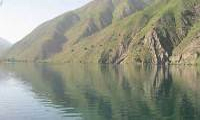
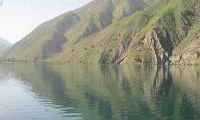
After at least a four-hour trip on a trail that is mainly steep and sunny, turn the col; you won’t believe your eyes when you come across a light-blue gem on the ring of the Zagros mountain range.
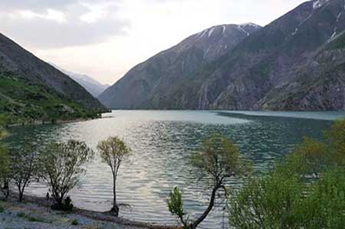
Right in the middle of the peaks of Zagros, in a protected area known as Oshtorankooh in Lorestan, you will find a lake over 2000m above sea level. It is so clear that you can see the bed of the lake a meter below the surface.
You have two ways to reach the lake, from Dorood and from Azna. When you enter Azna , a five-hour drive from Tehran, cars in its terminal can take you on a meandering path up to the environmental protection post-station of Oshtorankooh. If it is a forbidden season, you’ll have to get a pass from the Environmental Protection Organization (EPO) to enter as a tourist and mountain climber. If it’s fishing season, you are allowed to enter and see the blue gem.
To reach Gahar Lake, follow the paved path that ends up in a tiny pool. After a 100-meter hike through an upward path with a mild ascent, the steep main path begins. Once you go through it, you find the second spring, with drinking water. Beside the catchment there is a place to stop and rest where mountain climbers set up tents and build campfires on its cement pavement. Once you pass it and the river which comes from Gahar Lake, you are almost halfway there. After about a 2-hour hike on an easy trail and turning a col, the lake --not visible until now -- emerges. Local officials say every year around 70,000tourists visit the lake, some for fishing, some for swimming in the cool water, and some for mountain climbing and wandering.
That’s why a special place has been designed and built around it with campsites, public rest rooms, a rescue station and even solar batteries for charging cell phones, as well as other services. On its east side, which is barely accessible, another clear-water lake is visible in the distance. Its forests are not very wide and include sparse vegetation, but they are enough to provide you with permanent shade under which you can gaze at the flow of water on the ground. When it’s the season, you can get an inexpensive permit to go fishing. Of course there aren’t too many trout and experienced fishermen would say you can’t catch more than 3 fish a day. Animals in the area include: Persian leopard, brown bear, goat, ram, ewe, wild cat, hyena, wolf, fox, Shang, Dorry partridge, partridge, golden eagle, vulture, Egyptian vulture, hawk, Balaban, tiny kestrel, golden bullfinch, big-beaked bullfinch, pink starling, Ji Jagh, spurred tortoise, large-scaled rock agama, Gorzmar (kind of snake),
Horned viper, and snake-eyed lizard.
They have been immune from the cattle due to local people's attention and EPO supervision. From above you can watch beekeepers' colonies. There is concern over the thinning vegetation of the Zagros mountains. Factors include overgrazing, forests and steppes damaged due to global warming, hunting animals like hogs and squirrels which play a big role in maintaining vegetation and especially restoring oak forests, and leaving unextinguished fires behind when tourists visit. These all threaten Zagros and the protected area of Oshtorankooh. It’s a little difficult to stop them and prevent those who take advantage of its environment illegally. A simple online search can educate tourists on the wildlife, environment and preventing further destruction before they take trips to the region.
/J
.jpg "Beautiful Nature")
.jpg "Beautiful Nature")
.jpg "Beautiful Nature")
.jpg "Beautiful Nature")
.jpg "Beautiful Nature")
.jpg "Beautiful Nature")
.jpg "Beautiful Nature")
.jpg "Beautiful Nature")
.jpg "Beautiful Nature")
.jpg "Beautiful Nature")
.jpg "Beautiful Nature")
.jpg "Beautiful Nature")
.jpg "Beautiful Nature")
.jpg "Beautiful Nature")
.jpg "Beautiful Nature")